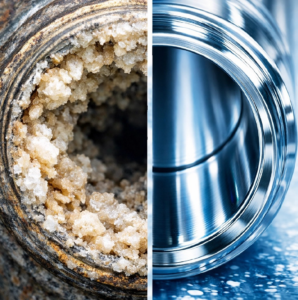
 Water hardness refers to the amount of dissolved calcium and magnesium in your water. While these minerals aren’t necessarily harmful to drink, they are a nightmare for your plumbing. When hard water is heated: like in your water heater or dishwasher: these minerals crystallize and form “scale.” This scale builds up inside your pipes and around the heating elements of your appliances. Think of it like cholesterol in your home’s “veins.” It slows everything down, makes your systems work harder, and eventually leads to a complete breakdown.
If you’re noticing white spots on your faucets or your soap doesn’t lather well, you have hard water. You deserve water that works for you, not against you. That’s why we offer a comprehensive water analysis to show you exactly what’s in your pipes.
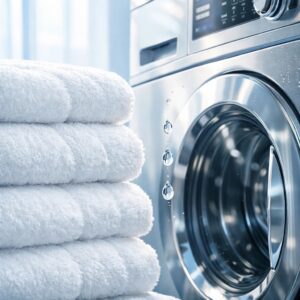 Hard water doesn’t just hurt the machine; it hurts your clothes too. Those minerals get trapped in the fibers of your towels and shirts, making them feel stiff, scratchy, and dull.
Internally, your washing machine faces the same scaling issues as the dishwasher. The pumps and valves get gunked up, leading to leaks and mechanical failure. Research shows that appliances exposed to hard water can have their lifespans cut by 30% to 50%. That means a washing machine that should last 10 years might give out in five.
While we’re talking about appliance protection, we have to talk about what else is in your water. Hardness is a physical problem you can see and feel, but there are other contaminants that can be even more concerning for your health and your home.
PFAS (Forever Chemicals)
Recently, the focus on PFAS in d
rinking water has skyrocketed. These “forever chemicals” don’t break down and have been linked to various health issues. While a water softener primarily targets minerals, we often install multi-stage systems that handle both hardness and chemical filtration.
Radium in Water
In parts of Maryland, like Phoenix, Maryland, homeowners on wells often have to deal with radium in water. Radium is a naturally occurring radioactive metal that can seep into groundwater. It’s odorless and tasteless, but long-term exposure is a serious health risk.
Nitrates in Water
If you live near agricultural areas, nitrates in water are a common concern. High nitrate levels can be dangerous, especially for infants.
At Liberty Pure Solutions, we don’t just fix pipes; we provide total water security. When we come out for a water-treatment consultation, we look at the whole picture: hardness, PFAS, radium, and nitrates: to ensure your family is safe.